

Presentation
The FORMULA project (Functional Organization of Living Matter : ModeLing and Analysis) brings together a consortium of scientists with shared interests in biological sciences, and aims to develop novel research methodologies for the multiscale exploration and modeling of living systems.
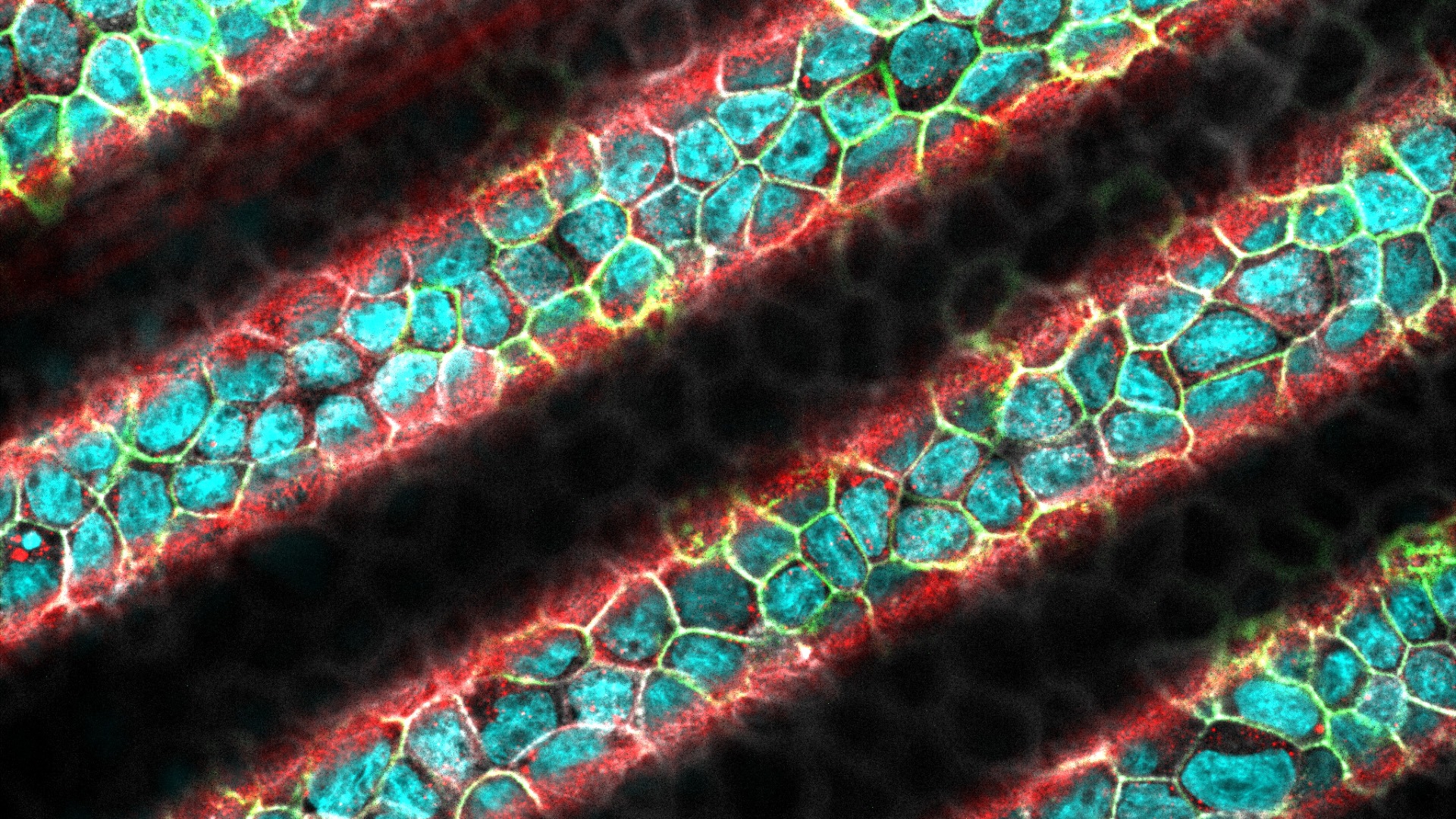
Epithelium on a sinusoidal substrate.
© Sylvie Hénon/Olivier Harmand.
Context and Objectives:
The organization of living matter is underlain by networks of physical and functional interactions, from macromolecular assemblies, i.e. multiprotein complexes and chromosomes, to organelles, cells, tissues, organs and ultimately, organisms. Such networks are further responsive to intrinsic and extrinsic cues, including biochemical signals and physical constraints triggered upon metabolic changes, cell cycle progression, stress responses, differentiation trajectories or developmental processes. Understanding the dynamic organization of these networks thus requires multiscale and integrative approaches that cannot be limited to the individual exploration of biological models through conventional strategies.
In this line, FORMULA explores and models the networks underlying biological systems, with a three-pronged philosophy: (i) collective, as it will mostly support initiatives aimed at developing cutting-edge methodologies shared by the consortium members; (ii) multiscale, as it will explore interaction networks at different scales, from biological polymers (WP1), to cells (WP2) and tissues/organs (WP3); (iii) pluridisciplinary, as it will structure two-way interactions between biologists and their research questions on the one hand, and the rich scientific expertise in physics and data analysis present within the consortium on the other hand, enabling the treatment of large datasets and the modeling of complex phenotypes, while providing relevant material to develop novel analytic tools
Project organisation :
The project is organized along three work packages :
WP1 (Biological assemblies) will explore and model the interaction networks underlying a large variety of biological assemblies such as multiprotein polymers, lipid membranes and chromosomes.
WP2 (Cells as functional units) will investigate how networks of interactions and genes are translated into cellular phenotypes, taking advantage of the large panel of cellular models, physiological situations and pathological deregulations studied by the consortium.
WP3 (The biogenesis of multicellular organisms) will use a multidisciplinary combination of genetics, imaging and biophysical approaches, to address how different cell types are specified and collectively organized within embryos, tissues or organs, in animals, plants, or fungi.